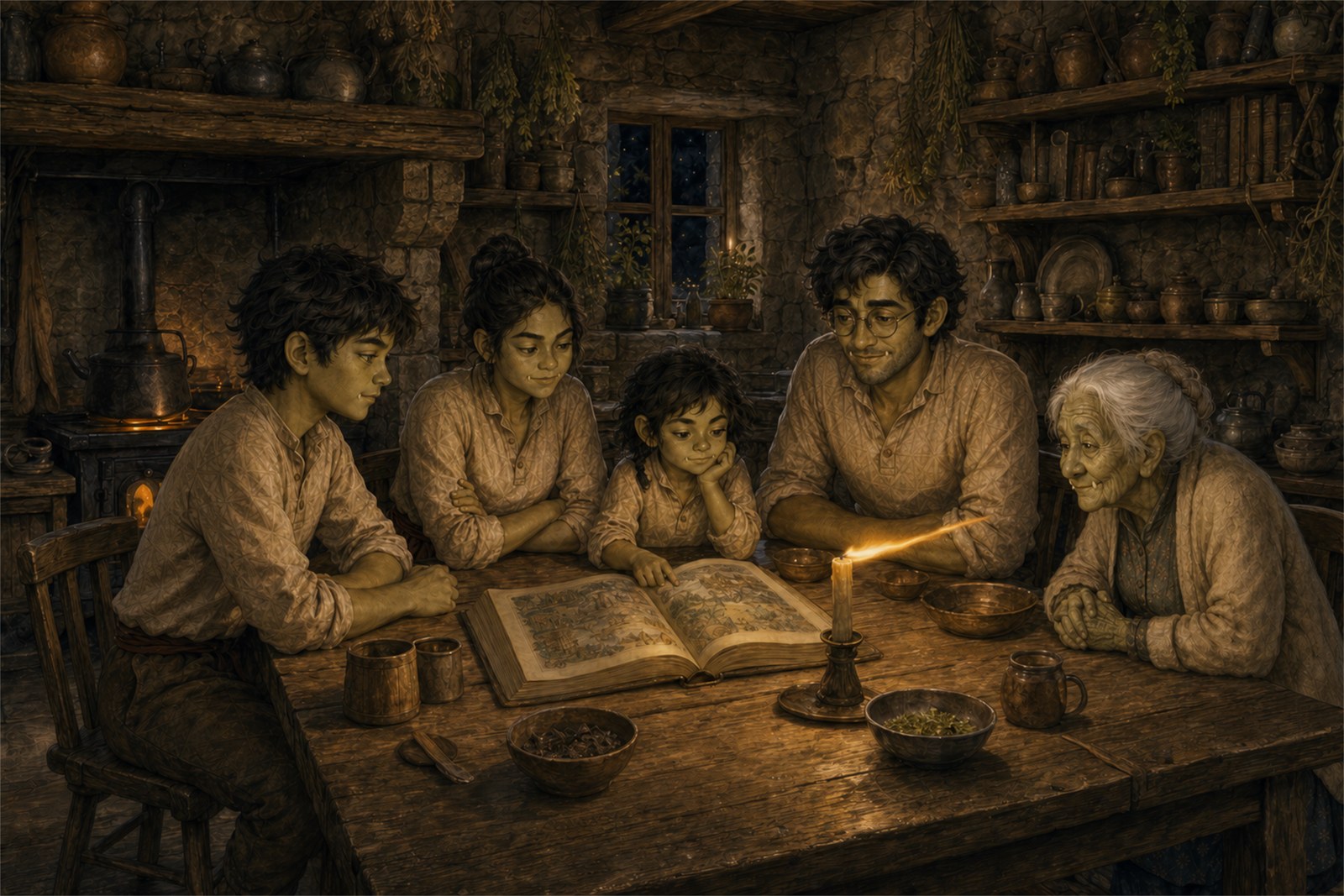
Chapter 2 – A Daydreamer's Morning

Chapter 2 – A Daydreamer's Morning

While the town's schoolchildren had long been hopping across the cobbles, west of the arch, in the little cottage at the forest's edge, Arlon still lay in bed. Blanket up to his nose, only his feet out in the open, tall for his age and perfectly motionless – except for an occasional twitch of the toes; more of an answer he did not grant the morning. Even the rooster's first crow left him cold. Only when the steam wagons wheezed out of their garages, when valves hissed and boilers groaned and the noise settled comfortably over the rooftops, did Arlon's eyes fly open.

"…what?"

Why were the wagons already out? His gaze fell to the window. Light. Far too much light. And the clock – oh, the clock. Arlon was late. Very late.

What followed, an observer might have taken for a little performance: a lanky boy shoots out of bed, gets tangled in his own blanket, hops into his trousers on one leg, snatches his school satchel and a slice of bread between his teeth – the little tusks make that practical – and storms out into the morning as if the fate of the Twelve depended on it.

The market was already awake. Traders shouted, crates clattered, a steam wagon chugged right through the crowd and sent everyone leaping aside. Arlon wove through it like an eel: dodging, braking, almost slipping on wet cobbles – the wrong way – back again – past a pressure-relief valve that puffed a warm cloud into his face. A market woman called something after him that was half scolding and half laughter. He tossed an "excuse me!" over his shoulder that nobody heard anymore, and ran on. Ever eastwards.

At the street corner stood the guards. "Hey! No running," one of them grumbled, without really straightening up. "You're spooking people." Arlon nodded, forced himself into a dignified stride, satchel pressed dutifully to his chest, the bread still in his mouth – a picture of perfect inconspicuousness. The guard looked at him, looked away and suppressed a grin. The moment the corner was behind him, Arlon broke into a run again.

Then the school came into view: a massive, angular building of pale stone, built by the Stalait and made for the Stalait – you could see that at first glance. The door frames low, the benches short and hard, hewn from a single piece, everything cut to stocky bodies, as the Stalait simply have them. For a Bamlait, every entrance was a small feat: turn the shoulders, lower the head, tuck in the knees. Arlon knew the drill. He even had his own technique for it. And as uncomfortable as the benches were – every morning he was glad anew to be allowed to sit here. For a long time, that had not been permitted at all; Bamlait children belonged in the fields, in the gardens, among the trees. That today he was allowed to wedge his shoulders between much too small stone benches was no annoyance to Arlon. It was a small piece of luck.

Lessons had long since begun. At the front stood Mrs Edeltraut, an elderly Stalait teacher of the kind that seemed to have always been there – the school had known her for ages, and she had known all of Ura for ages; she had probably taught the parents and, before them, their parents. She raised an eyebrow as Arlon came in. "What happened?" Arlon opened his mouth. "Ah." She waved it off before a word could come. "You overslept again." A quiet giggle ran through the class. Arlon turned red, pushed his lower lip over his tusks, nodded and squeezed into his seat.

"We are on the Stanner," said Mrs Edeltraut, tapping the pointer against the board, where mountains, caves and smithing marks were incised. "Arlon. You weren't here – but perhaps you know it anyway. Who are the Stanner?" Arlon blinked, collected himself – and spoke. Of the Stanner, an old dwarven clan from the mountains, stocky and long-lived, with beards that men and women alike were proud of. Of long winters deep in the rock, of hidden halls, of the art of not merely shaping metal but of reading in the ore what lay within it. Of how they left their caves only when they had to – to trade, to show their work. When he finished, there was a moment of silence. Mrs Edeltraut studied him. "Well then," she said at last, and in her stern gaze something flickered that was almost a smile. "At least you didn't miss anything."

Then she set the pointer aside. She rarely did that, and it meant: now came something that mattered to her.

"And mark this." She looked not at the board but into the class, from the back rows to the front. "Long ago, when the world was in turmoil and the humans did not know where to turn, the Stanner opened their halls to them. They offered shelter in the stone, shared fire, bread and their craft. And over the years, at the same hearth, at the same work, they were no longer two peoples. That is you, Stalait: humans who found a home in the mountain, and dwarves who did not hold their door shut."

She took a step to the side, towards the tall children in the too-small benches.

"And outside, on the roads, the same thing happened once more. The Bammer, the travelling gardeners, took lost humans into their caravans, shared road and garden. There too, from two grew one – and that is you, Bamlait." Her gaze slid over strong shoulders, over tusks, over the green-tinged skin that shimmered in the morning light almost like young foliage. "From the shelter of the one, from the road of the other. Different? Certainly. But at the root, the same story: strangers who became family because someone did not hold the door shut. You did not inherit the stone and the garden against each other, but for each other."

She let that stand for a moment. Then, more drily: "And whoever laughs next time at a classmate's too-small bench was not paying attention in this lesson."

A few Stalait children turned red. Arlon, in his much too small bench, suddenly sat up a little straighter.

While Mrs Edeltraut went on speaking, he drifted off – but this time not far. He thought of the Bammer, who were still out there somewhere carrying their gardens from place to place, never resting, and of how strange and beautiful it was that from this eternal wandering, of all things, he had come – he, who so loved to stay. Perhaps, he thought, that was why he so liked being in this too-small school. Because it stood. Because it stayed.

"Arlon." No reaction. "Arlon." Then, louder, from half the class at once – his name. He flinched, and the giggling surged up again – but this time it was, in some measure, a friendlier one. "Pay attention," said Mrs Edeltraut, without sharpness, and turned back to the board. Arlon listened. This time, truly.

And for the rest of the lesson he even forgot that the bench was too small.

Continue to Chapter 3 – Break and Telling-Off →