Chapter 6 – The Harvest Festival

Chapter 6 – The Harvest Festival

There is one day a year in Ura on which the town forgets that it is in no hurry – and instead spends the whole day being slow with all its might. That is the Harvest Festival.

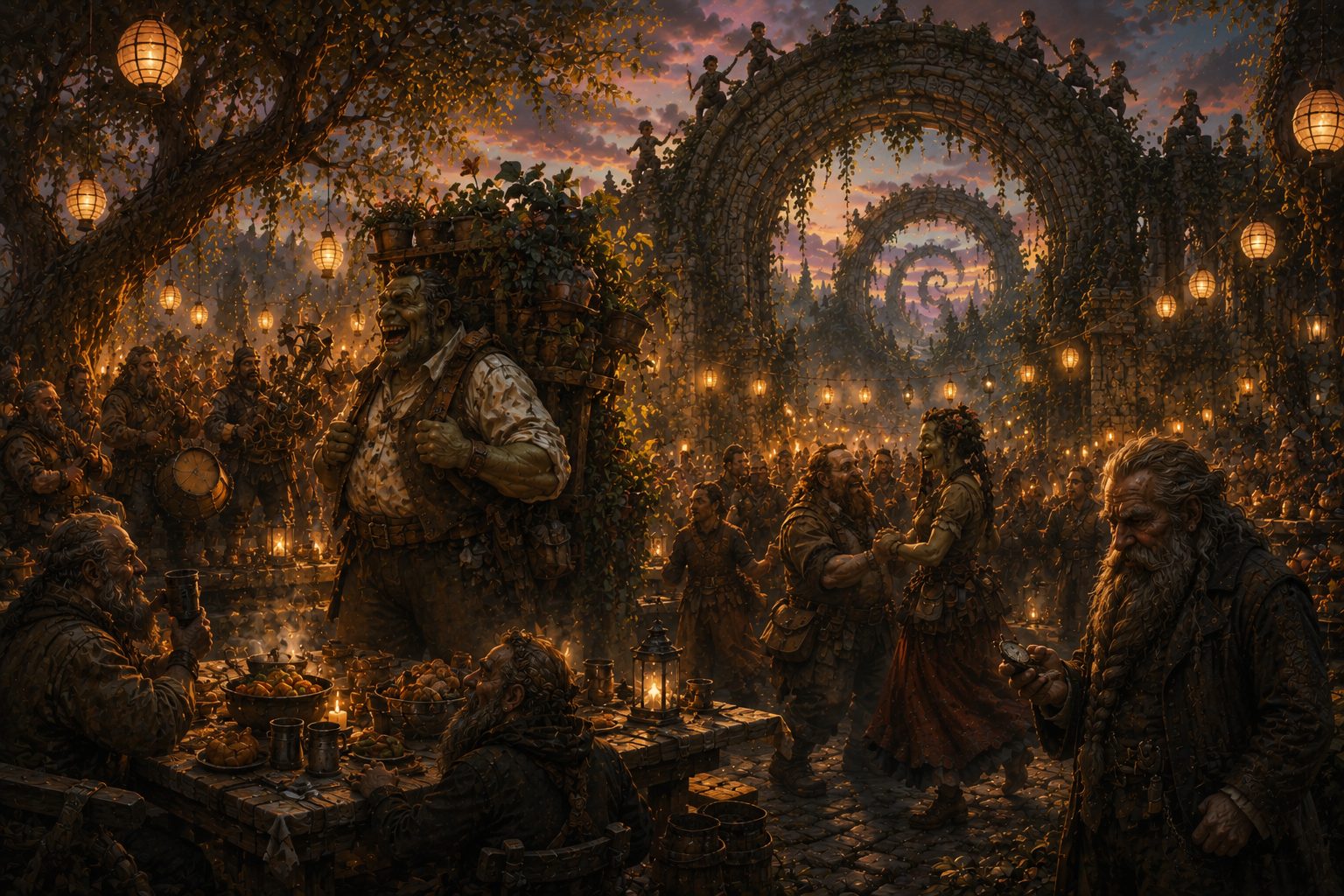
Even in the morning, it smelled different. Not just of wood smoke and bread, but of everything at once: of roasted game and mushrooms in butter, of hot cider, of herbs steaming in great pots over open fires, of freshly planed wood, because tables and stages were sprouting from the ground everywhere. The old gardens around the Great Arch, usually quiet and a little enchanted, had overnight become one single long festival ground. Lanterns hung between the wandering olive trees, and the arch itself stood in the middle of it all, solemn and friendly at once, while children clambered over it just as on any other day. To them, it was no riddle. To them, it was the best lookout onto the festival.

This time, Arlon was not late. The twins had seen to that – on festival day, not even Arlon overslept, and if he did, there were Thalia and Torma. They pulled him along, Mira was already dancing three steps ahead, Frika carried a basket that looked heavier than Mira, and Jorin lugged something home-built that was supposedly meant to crack nuts and would probably blow half the festival sky-high. Alma came last, slowly, with that little smile she always wore on festival days, as if she already knew how the day would end and looked forward to every moment in between all the same.

On the square, things mingled that otherwise politely kept out of each other's way. The Stanner had brought their drums and pipes, along with strange mechanical instruments that puffed and jingled and kept time all by themselves. The Bammer answered with song, with horns and flutes, soft and wide. For a while, it seemed as if two festivals were playing at once, each for itself. Then someone found the right moment, and suddenly drum and horn fit together as if they had always belonged to each other – different, certainly, but at the root the same joy. People danced, Stalait and Bamlait in colourful mix, and nobody counted anymore who came from where.

Lirya found Arlon at the cider table. "You're on time," she said in place of a greeting, studying him as if this were a suspicious natural phenomenon. "I'm impressed." "Enjoy it," said Arlon. "It won't happen again." They laughed and let the current of the crowd carry them along, from stall to stall, until a murmur ran across the square – that special murmur that only exists when someone arrives whom everyone has been waiting for.

"BRANN!"

You heard him before you saw him. A laugh, deep and infectious, rolling over the heads, and then the crowd parted, and there he was: a Bammer, tall even for a Bammer, broad as a barn door, with tusks he showed generously when he grinned, and skin that shimmered in the lantern light almost like old foliage. Over his shoulder he carried, as always, a small wandering garden – a frame full of pots from which herbs and vines spilled, some of them in colours Arlon had never before seen on a plant. Brann hugged half of Ura at once, lifted Mira up so that she squealed, clapped Jorin on the shoulder so heartily that he dropped his nut device, and called something to Frika that was lost in the noise but made her laugh.

Then he saw Alma. And for a moment, the loud Brann became very quiet. He went to her, took her small hand in his enormous one and bent down, and what he said to her, nobody heard. Alma smiled, patted his cheek like a child's and said something back that made him laugh again – but shorter this time, and with wetter eyes than a laugh explained.

"And where, I ask myself," said a second voice, calm, dry and utterly unimpressed by the bustle, "does a Bammer actually leave his manners when he travels? In the same pouch as the soap, I assume. Both unused."

Edward.

He was the exact opposite and yet stood beside him as a matter of course: a Stanner, stocky and upright, with a carefully braided beard and a waistcoat whose small buttons flashed in the light like clockwork. Indeed, as he spoke, he drew a flat watch from his pocket, looked into it as if the course of the world depended on it, and made it disappear again. Everything about him was calm, polite and a shade too wistful for a festival.

"Edward!" Brann bellowed with delight and enclosed him in an embrace that the smaller Stanner endured with the patience of a man who has been putting up with this for years. "You smell of machine oil and bad temper." "And you of everything else," Edward replied, smoothing his waistcoat and regarding Brann's wandering garden with polite horror. "One day something will grow out of that thing and devour you, and I shall stand by and say: I foresaw it." "And then," said Brann contentedly, "you will still be sad." Something flitted across Edward's face – not a contradiction. "Yes," he said only. "I will."

Arlon liked the two of them at once, the way all of Ura liked them. They were like an old song you gladly hear anew every year. And yet there was, beneath the teasing, something he couldn't quite grasp – as if these two fundamentally different men in truth shared one and the same thing, too heavy to speak aloud, and therefore better joked about.

It became even clearer when Mrs Edeltraut joined them.

The stern old teacher, whom Arlon knew only from the blackboard and her "no running!" look, was someone else here. She said nothing special – a nod to Brann, a quiet word to Edward – and yet something changed as the three stood together. They didn't talk much. They didn't have to. It was as if they belonged together like three parts of something that had been taken apart and scattered along far roads. Brann laughed, Edward looked at his watch, Edeltraut gazed towards the arch – and for one tiny moment, all three fell silent at the same time, entirely without reason, like three people hearing the same distant note.

Arlon only caught the end of it. But Lirya had seen it.

"Did you notice that?" she asked quietly, close to his ear, her gaze still on the three of them. "Notice what?" "They all stopped at the same moment." She said it without excitement, matter-of-factly, the way she said things she had noticed. "Brann laughs loudest when he looks at the arch. Did you see? The merrier he acts, the further away his eyes are." She tilted her head. "They're happy to be here. And at the same time it hurts them. Both at once."

Arlon looked at her. He could not have put that into words – he hadn't even properly seen it. Lirya had. She saw such things, it struck him, not for the first time: not what was loud, but what lay quietly beneath.

"You're uncanny," he said, and meant it as a compliment. "I know," she said, grinning crookedly. "Come on, they're about to dance."

And it became a good evening. Brann danced with half of Ura, lifted Mira up again and again, told stories of places whose names Arlon didn't know and which sounded too far away to be true – of lights that did not come from fire, of wagons without horses and without steam, of a sky that looked different. The children took it for fibbing and loved it. Edward sat most of the time at the edge, a cup of hot cider in his hands, watching the goings-on with that smile that always smelled a little of farewell. Once, Arlon asked him where he came from, just like that. Edward looked at him for a long time, and then said only: "From far away, young friend. And from quite near. Both are true, and that is the difficult part." Then he refilled Arlon's cider, as if that settled everything.

Late, when the lanterns were burning down and the music grew softer, Brann and Edward stood together at the foot of the arch, and Arlon, who was really only looking for his cap, overheard a few words that were not meant for him. "How long this time?" asked Edward. "Three days," said Brann, and everything loud had vanished from his voice. "Maybe four. Then it calls again." "Me too," said Edward. They were silent, two men before an old stone, each with one home too many and neither with the right one.

Arlon took his cap and went quietly back to his family, without understanding what he had just heard. He only knew that these two men, whom all of Ura laughed about and everyone was glad to see, carried something with them that weighed more than Brann's garden and kept truer time than Edward's watch.

Above them, in the fading light, stood the Great Arch, watching the festival as it watched everything. And Arlon could have sworn that Brann, before he left, nodded once more – not to the people. To the arch.