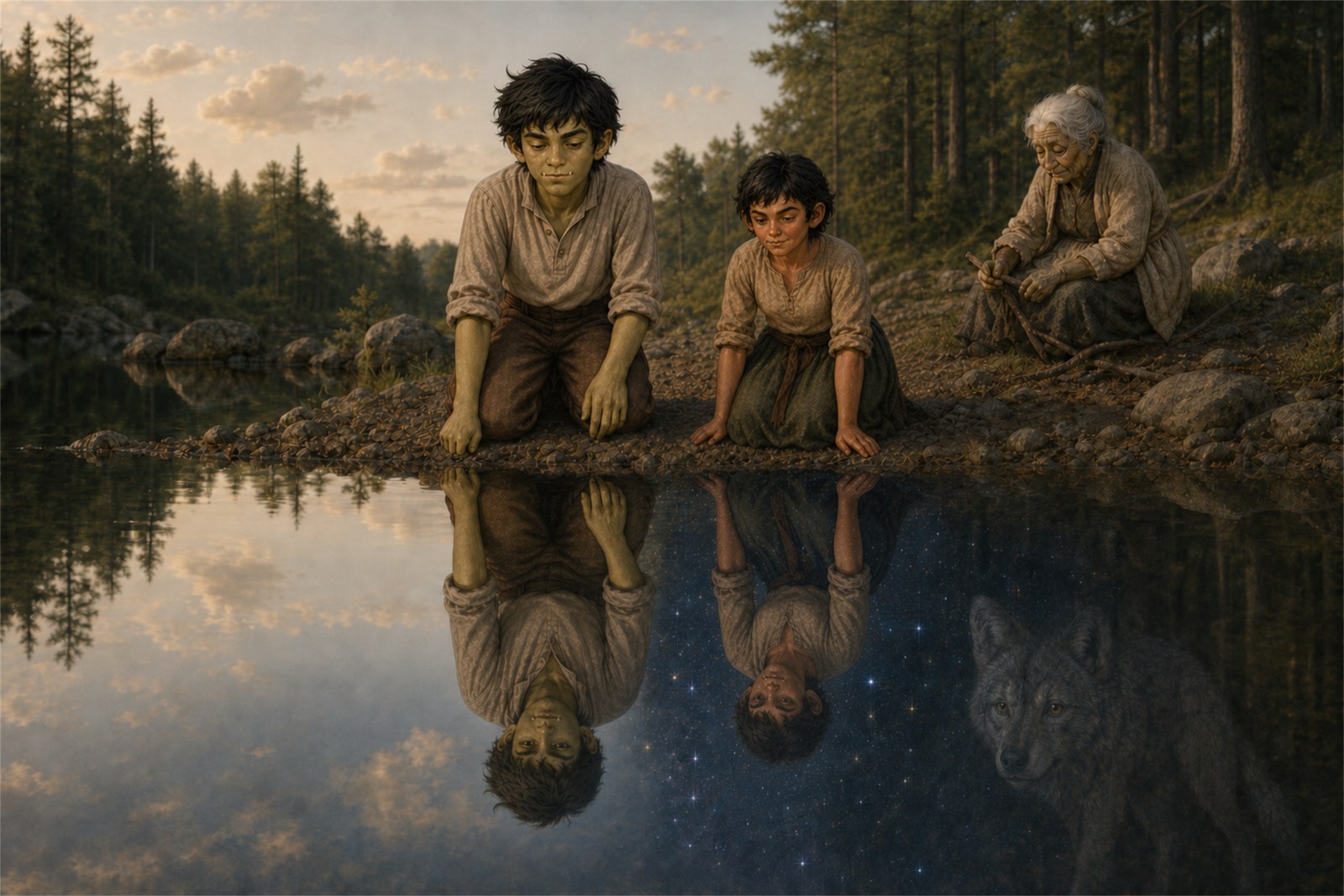
Chapter 4 – The Kitchen-Living Room
The kitchen-living room was not a room you entered – it took you in. A large, open space where the floor had been worn smooth by generations, traces of smoke clung to the beams, and every table had at some point been everything: workbench, dining board, storage, sickbed, playground. Here, people cooked, argued, laughed, repaired and sometimes kept silent. Usually all at once.
The door flew open. Thalia and Torma were first. As always.
They shot straight across the room, heading for the big table where their father sat. Jorin was bent over a strange contraption of wood, wire and metal; from between screws, springs and a bent whisk protruded something that seemed to want to stir, beat and explode all at the same time. He had been working on it for days. "Honestly," Thalia began without full stop or comma – "– you can't just oversleep every single morning –," Torma continued seamlessly, "– as if time were something voluntary," they finished together. Jorin did not raise his head. Only an eyebrow. "He was last again," said Thalia. "Slicked up like a hedgehog after the rain," added Torma. The second eyebrow twitched. Arlon stood at the edge of the room, satchel hanging crooked from his shoulder, and let it wash over him like rain that isn't going to stop anyway. Jorin slowly set the tool aside. Very slowly. Turned around. Looked at Arlon. Opened his mouth –
THUMP.
The dull blow made the table tremble. Frika, Arlon's mother, had come in and, with a single powerful swing, thrown a dead goat onto the tabletop. The animal lay there, heavy and final. "The meal needs preparing," she said matter-of-factly.
A shrill scream tore through the silence.
"NO! NATASCHA!"
Mira, the youngest, burst out of a corner, tears in her eyes, hands balled into fists. Frika looked at her calmly. "You've been saying for hours that you're hungry." "But Natascha was my best friend!" "It's a goat. And we want to eat." "You always kill my best friends!" Mira stamped her foot. "Last week it was Hannes! And before that, Joachim!" Frika sighed and rolled her eyes. "You're not supposed to give the animals names. This is a farm, not a children's choir." Mira held her mother's gaze. "Then Angie is next," she muttered defiantly, squinting towards the window. "Definitely. Angie's grazing out there."
Alma, the grandmother, raised her head from her chair by the stove. "Angie?" she asked mildly. "Isn't that the neighbours' child?" Frika paused. "I am most certainly not going to slaughter a neighbours' child." Alma nodded slowly. Then she laughed, short and dry. "Good. That would have got complicated." And with that, amid mild general confusion, the subject was closed.
Frika reached for a sharp knife, practised and sure, and began to butcher the goat as if it were just another chore of the day. Jorin stood up, resolutely pushed his unfinished kitchen device aside and put water on. "I'll see to the fire," he said – not a question, a decision. The room got going like a well-oiled gearbox: Torma sorted wooden bowls, Thalia set out cups and wordlessly handed her mother a cloth, Arlon carried plates over, set them down, picked them up again because they weren't standing quite right. Alma slowly peeled roots by the stove, every movement deliberate, as if following an inner rhythm, humming something nobody recognised.
Only Mira stood in the middle of the room, hands behind her back, her gaze too alert, too calm. She was waiting. And then she called out, loud and clear:
"Thalia is in love with Eran!"
The room froze. Alma was the first to laugh. "Oh, how lovely. Young love in the house." "Mira!" Thalia spun around. "And his beard is already really mighty!" Mira added enthusiastically. "MIRA!" Alma tilted her head. "A Stalait boy, then?" "Alma," said Jorin warningly, without turning around.
But Alma had already picked up the thread and would not let it go. "The ones with the torches," she murmured, straightening up in her chair. "The ones who so like to burn trees." "Grandmother—," Frika began. "I saw the trees burning!" Alma declared with a decisiveness as if she were speaking of yesterday afternoon. "My father put out the fire and then set off to fight them. It took three fighters of the Inquisition to stop him. Three!" She held three fingers up in the air, as if that were the punchline of a good story and not the end of a terrible one.
"Do you want us to have the Inquisition in the house?" asked Jorin, calm but emphatic.
Alma waved it off as if shooing away a midge. "Besides," said Frika drily, without looking up from the knife, "you raised that boy's father." Alma paused. Then she nodded, deeply satisfied. "Yes. And that is exactly why I know that rascal inside out."
"Stop it, please," said Thalia quietly, and her voice suddenly lost all its defiance. "It's so embarrassing. And… we don't even know yet whether he likes me at all." She looked at the floor. "Maybe I'm not good enough for him."
Alma leaned forward, suddenly all conspirator. "Not good enough?" She snorted. "Why shouldn't he like you? Or are you not good enough for him?" Thalia blushed to the tips of her hair and no longer knew whether that had been a comfort or the opposite. "Pah!" Alma went on, drawing herself up combatively before anyone could answer. "I shall tell his father, that rascal, that our family – which is his family too, after all – had jolly well better be good enough!"
For a moment, everyone tried to follow this logic. Was Thalia too good, the boy too good, or were they all related to each other anyway? Before anyone could untangle it, Alma had already wandered on – back to torches and orders and men with cold eyes – muttering something about "the Beguiled", as if it all quite naturally belonged together.
"That's enough," said Jorin. Not harshly. More tired, like someone who has ridden this ride many times before.
"The Beguiled?" Mira's voice burst in, bright and curious. "What are the Beguiled?"
For a tiny moment, it grew a shade quieter. Frika's knife paused, just for a breath, then went on cutting. And Alma, a moment ago all storm and indignation, suddenly became calm – so abruptly that it was almost more unsettling than her raging. "Some words," she said softly, "are too heavy for a kitchen where cooking is under way." She rose with effort, went to the bookshelf and let her fingers glide over the old spines until they caught on a thick volume. She pulled it out and held it for a moment, as if it weighed more than mere paper. On the cover, stone and wood entwined, and on the spine it said simply: A History of Ura.
"This," said Alma, "we old ones made so that nothing would be lost. In pictures – those are for you while you are small. And in words that wait until you are ready." Mira received the book reverently and opened it. Her fingers slid over drawings: over arches and gardens, over burning shapes and entangled lines she did not understand and which nevertheless seemed important to her.
Arlon stood quietly beside her. He knew this book. Every page. While Thalia and Torma had only ever had to know it, Arlon had read it, again and again, and to him it had never been a weight but a treasure: knowledge that stayed.
Alma laid her hand on Mira's head and stroked her hair once. Her gaze was warm – and for a moment a little distant, as if she were seeing through the pages to something that was not printed there. Then, in the very next breath, her expression brightened again. "Right," she said briskly, clapping her hands. "Which of you rascals is setting the table?"
The stove crackled. The water began to sing. And between pictures no one had to understand yet and words that could still wait, the evening closed slowly and very gently around them all.