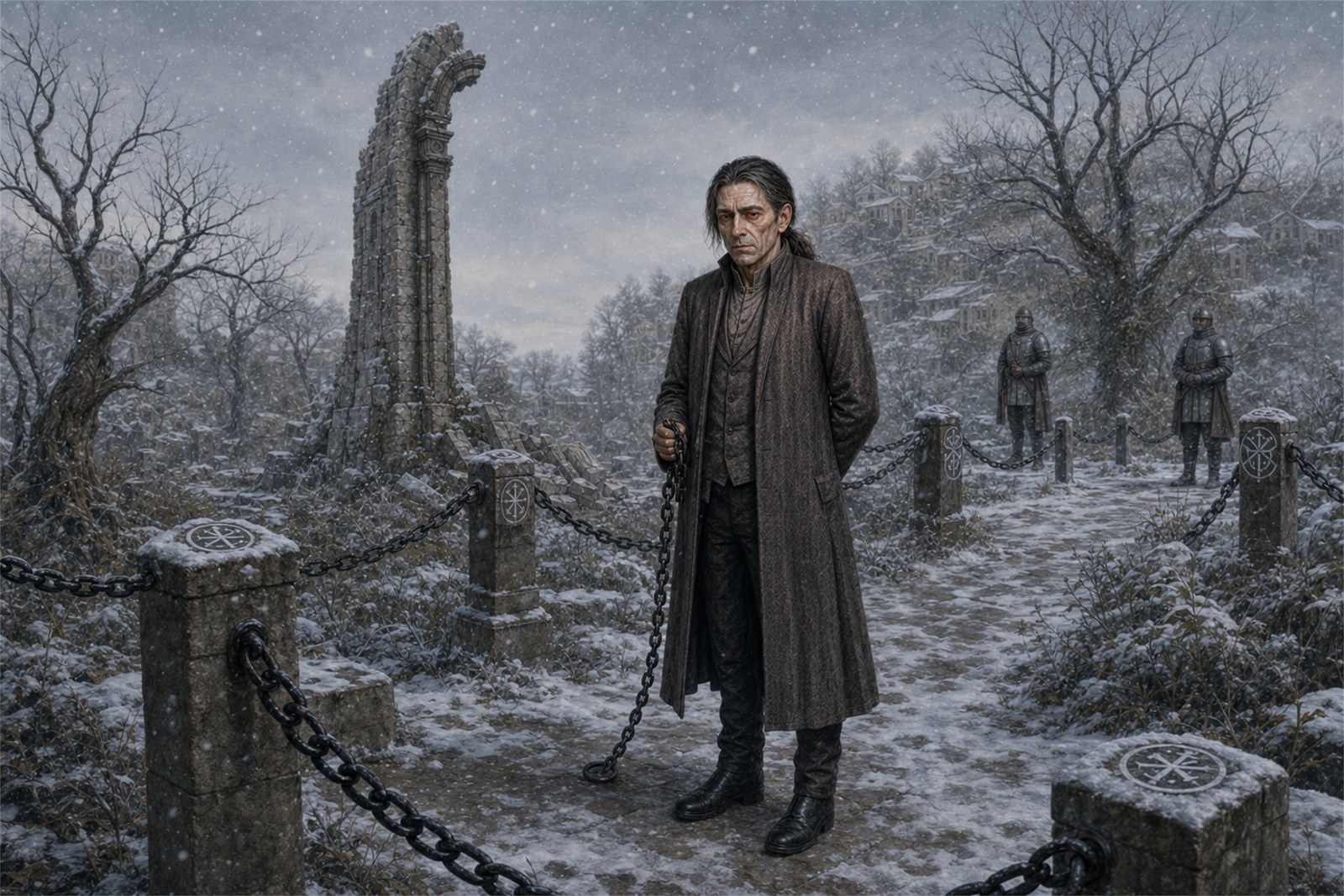
Chapter 5 – The Beguiled
That night, Arlon found no sleep.
That was unusual, for sleep was one of the few things that came to Arlon effortlessly. He could sleep anywhere: on benches that were too short, in the grass, once even standing up, leaning against a warm stable wall, until Angie had eaten the cap off his head. But tonight he lay awake, blanket up to his nose, only his feet out in the open, and above him in the dark a single sentence paced back and forth, always the same round, and would not lie down.
What are the Beguiled?
Mira had asked, bright and curious, the way she asked everything. And the room had grown quieter for a breath, Frika's knife had paused, and Alma, all storm a moment before, had suddenly become calm – so abruptly calm that it had frightened Arlon more than all the raging before. *Some words are too heavy for a kitchen where cooking is under way.* Then the book, and Mira's fingers on the burning shapes, and the evening that had closed gently around them all like a warm hand.
But a warm hand also holds on. And Arlon lay awake.
At last he gave up. Carefully he slid his feet onto the cool floor, and the floorboards, which betrayed everyone in the house, betrayed him too – only more quietly, as if they knew it was night now. In the big room, the stove still glowed, a tired, red gleam, and on the table, where the goat had lain and long since become supper, lay the book. *A History of Ura.* Mira had left it open, the way children leave things that matter to them and that they can no longer carry just now.
Arlon knew this book. Every page. While Thalia and Torma had only ever had to know it, he had read it, again and again, and to him it had never been a weight but a treasure. He knew the pictures by heart: the arches, the gardens, the entangled lines. But beneath the pictures stood the words that wait, and though he had read them, often even, he had never quite understood them. They were like a song in a language you almost speak.
Tonight he read them differently. Tonight he was searching.
And he found the word. It stood in the middle of a page where the burning shapes twined, plain and without explanation, as if whoever had written it had hoped no child would ever have to ask about it.
*The Beguiled.*
"You won't find it there."
Arlon flinched. By the stove, in her chair, sat Alma. She had been sitting there the whole time, motionless in the red half-dark, and he hadn't noticed her – or she had only just arrived; with Alma, you never quite knew. Her eyes were awake. More awake than old eyes ought to be in the middle of the night.
"Sit down, rascal," she said, patting the stool beside her. "If the question won't let you sleep anyway, then at least let it keep you warm."
Arlon sat down. For a while, neither said anything. The stove crackled; outside, a bird called that had no business calling at this hour, and fell silent again.
"I was as small as Mira," Alma began at last, "when I first saw trees burn."
She spoke slowly, without her usual verve, without the punchlines she otherwise loved so much. Of a time when the Bammer still passed more often through the forests around Ura, their gardens travelling from place to place, bringing something to bloom wherever they rested. Of groves that were sacred to them, old and still and full of birds. And then of the men who came one summer, with torches and with calm, friendly voices.
"That is what hardly anyone believes," said Alma. "They did not shout. They did not threaten. They came and said they were bringing order. They were bringing healing. They said the world had once been broken, long before us, and so that it would never break again, some things had to disappear. A few old trees. A few old songs. A small price, they said, for the safety of all." She looked into the fire. "And the terrible thing, Arlon, is this: some believed them. Here. In Ura. People I knew went over to them, entirely of their own free will, and helped burn down the groves they had played in as children. They held the torches themselves."
"Why?" asked Arlon quietly.
"Because they had been promised something." Alma folded her old hands in her lap. "Imagine there lived more than one voice inside you. Not loud, not mad – simply more than one. One that wants to stay, and one that wants to wander. One that is today, and one that remembers something you yourself never lived through. Most people carry these voices within them all their lives without ever thinking about it, just as you breathe without thinking about it." She paused briefly. "And now imagine someone came and said: *That is your misfortune. That second voice – that is the crack in you. Give it to me, and I will make you whole.*"
Arlon thought about it. "And – does it make you whole?"
"It makes you *quiet*," said Alma. "That is not the same thing, even if it feels like it for a while. They brought the one voice to shout the other down forever. And a person in whom only one voice still shouts while the other has fallen silent – that person will hold the torch for you if you tell them to. That person is strong, and certain, and terribly lonely, and notices none of it. Those, rascal, are the Beguiled. Not monsters. People who made a trade they thought would make them whole."
It was quiet. Arlon noticed he had wrapped his hands around his knees, very tightly.
"And your father?" he asked. "You said he put out the fire first."
The corner of Alma's mouth twitched, half pride, half something else. "First the fire," she said. "Always the fire first. What burns, you put out before you quarrel – that was his way. And then he set off, against them, alone, and it took three fighters of the Inquisition to stop him. Three." She raised, just as she had that evening, three fingers into the air. But this time she did not laugh as she did it.
Arlon looked at her, that small, old face in the red light, and inside him grew a question, bigger than all the others, and it came out before he could stop it.
"Alma – how do you know all this?"
And then something happened that would occupy Arlon for a long time to come.
Alma did not answer. Not at once, and not the way she usually answered – with a joke, a digression, an "oh, rascal". She grew still. Her gaze stayed on the fire, but it went through it, through the embers and through the wall behind them, through something Arlon could not see and of which he was suddenly certain that it lay far, far away. So long that the silence grew heavy. So long that Arlon heard his own heartbeat.
On the table stood a candle, long since burned down, its flame a calm, straight little line. And while Alma was silent, that flame leaned. Very slowly, very gently, to one side – though no window stood open, though no breath moved through the room, though nothing, nothing at all, stirred. It leaned as if listening into the same distance as Alma.
And Arlon thought he heard a word. Just one, softly, close to his ear, in a voice he did not know and which yet sounded as if it knew him. He did not understand it. It was scarcely more than a breath. But it had been there, he knew that as surely as he had ever known anything – and in the same instant that he turned towards it, it was gone, and the candle stood straight again, and the room was only a room.
"Alma?" he whispered.
She returned. You could positively see it, how she came back, out of the distance into the chair, into the night, into the little cottage at the forest's edge. And then she smiled, warm and a little tired, and laid her hand on his head, the way she had done with Mira, and stroked his hair once.
"That," she said, "I will tell you when you are ready to hear it."
"Am I not?"
"Not yet." There was no harshness in it, rather something like tenderness, and perhaps a trace of sorrow. "But soon, I think. Sooner than I would like." She looked over to the door, to the forest beyond, which you could not see and yet always felt. "The arch is not broken, Arlon," she said quietly, and this one time she did not say it to the room, not as decoration for one of her stories, but to him alone, eye to eye. "It is only waiting. As so much here waits. And the waiting is coming to an end."
Then, in the very next breath, she was the old Alma again. "Right," she said, patting him on the shoulder. "And now you sleep. A head that broods at night is good for nothing in the morning, and I know at least one rascal who is good for nothing in the mornings anyway."
Arlon smiled despite everything. He got up, walked the few steps to his bed, and as he pulled the blanket up to his nose again, he heard Alma humming something in her chair, softly, the old song that nobody recognised. And strangely, the sentence that had kept him awake all night now lay down of its own accord. Perhaps because it had an answer. Perhaps because a much bigger question had taken its place – one that made him more tired than any answer.
Arlon slept. At last, and deeply, and without dreams – or with one he would not remember.
And that is exactly why he heard neither the rooster nor the steam wagons.
"He's still asleep."
"Of course he's still asleep."
The voices came from very near and very much above. Arlon squinted one eye open. Above him, against the far too bright morning light, two familiar outlines, same stance, same look: Thalia and Torma, already fully dressed, satchels shouldered, and on their faces that expression only siblings can manage – half reproach, half something they would never call care.
"Get up," said Thalia.
"Right now," said Torma.
"Not today."
"Today you are not going to be late."
"Not again."
"The three of us are walking together."
Arlon needed a moment to grasp that this was not a telling-off. Or it was one – but one that took him along instead of leaving him behind. Before he was properly awake, Thalia had thrown him his trousers and Torma had pressed the bread into his hand, a slice, already buttered, and outside the morning was full of noise and light and the smell of wood smoke and hot iron, just like every morning, and yet a little bit different.
The three of them ran across the cobblestones, Thalia in front, Torma half a step behind, and Arlon in the middle, the bread between his tusks, the little fangs that made that so practical. At the street corner stood the guard, saw the three of them coming, saw Arlon – right between his siblings, punctual, almost dignified – and raised an eyebrow in surprise.
"Well," he grumbled. "What happened *today*?"
Arlon wanted to answer. But he realised he couldn't, not in words a guard at a street corner would have understood. Last night, something had leaned, very slowly, very gently – a flame, without wind, in a silent room. And it had not yet quite straightened again.
So he did the only thing left to do. He shrugged, pushed his lower lip over his tusks and let his siblings shove him onwards towards school.
On time. For the first time in a long while.
And above the rooftops, in the distance, the Great Arch stood in the morning light and waited, as it had always waited – except that on this morning, for the very first time, someone in Ura looked at it and waited back.